
COLLABORATION TOWARD A SUSTAINABLE FUTURE AT THE 2026 ASIA-PACIFIC SUSTAINABLE BUSINESS SUMMIT
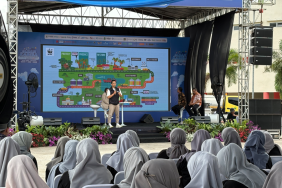
Held at the Indonesia Convention Exhibition on June 23, 2026, WWF-Indonesia participated in the Global Sustainable Development Congress: Asia-Pacific Sustainable Business Summit, an event bringing together various sectors—including academia, business, government, and universities—to discuss and strengthen collaboration in promoting sustainable development. Through various discussion topics and workshops, participants were encouraged to strengthen collaboration and foster tangible solutions that can have a positive impact on people and nature.
At this event, WWF-Indonesia had the opportunity to serve as a panelist in three discussion sessions. One of these was a session titled “Strategic Supplier Engagement for Shared Sustainability Impact,” featuring Ahmad Fahri Syafri, Strategic Engagement Specialist at WWF-Indonesia, alongside two other speakers. During the session, Fahri emphasized that cross-sector collaboration is key to addressing various sustainability challenges, ranging from deforestation and climate change to improving supply chain transparency. For example, WWF-Indonesia is collaborating with the Coordinating Ministry for Food Affairs, palm oil industry stakeholders, and partners in China to promote commodity supply chains that are free from deforestation and support land conservation. According to him, cross-sector collaboration is increasingly important in efforts to achieve sustainable supply chains, from producers to markets to consumers.
In the next session, titled “Tropical Commodities and Responsible Supply Chains” and featuring five speakers—one of whom was Angga Prathama Putra, Acting Director of Climate and Market Transformation— In his presentation, Angga discussed sustainable supply chain practices for tropical commodities such as palm oil, cocoa, rubber, pulp & paper, tea, and natural fibers through strengthening compliance, environmental and social risk management, improved traceability, partnerships with smallholder farmers, and regenerative and landscape-based approaches to protect forests and ecosystems.
In the session “Scaling Nature Markets for Corporate Risk Management,” led by Aditya Benyamin, Sustainable Conservation Financing Specialist, and moderated by Renard Siew, the discussion focused on leveraging carbon credit and biodiversity markets to support corporate risk management, ESG reporting (GRI, TNFD, SBTN), and nature-based investments. Topics included developing credits aligned with supply chain risks, valuing environmental and social benefits, leveraging SDG commitments to build collaborations, and strengthening biodiversity market standards and regulations.
In addition to these three sessions, the Global Sustainable Development Congress also featured a variety of discussion sessions and collaboration forums held from June 22–25, 2026. Topics discussed range from climate change and biodiversity conservation to the energy transition, the economy, and strengthening the roles of the education sector and the private sector in achieving the Sustainable Development Goals (SDGs).
Through its participation in this meeting, WWF-Indonesia is helping to promote cross-sector collaboration as a crucial step toward delivering solutions that have a tangible impact on the balance between humans and nature. Forums like this are expected to serve as strategic spaces for sharing experiences, strengthening partnerships, and achieving shared goals toward a more sustainable future.