
NATIONAL CHILDREN’S DAY 2026: PROTECTING NATURE, PROTECTING CHILDREN’S PLAYSPACES
“Every child has the right to grow up in a healthy, safe environment full of opportunities to play, learn, and explore the world around them. Amid the rapid pace of digitalization, nature remains an irreplaceable space for realizing that right.”
Indonesian children today are growing up in a digital age that offers many benefits but also presents new challenges. Data from the Ministry of Communication and Digital Affairs (Komdigi) shows that nearly half of Indonesia’s internet users are children and adolescents under the age of 18. In fact, the average screen time (screen time) for Indonesian children has reached approximately 7.5 hours per day. This situation indicates that children are spending an increasing amount of their daily lives in front of screens, thereby reducing their opportunities to play outdoors, interact with nature, and learn through hands-on experiences.
In the spirit of National Children’s Day 2026, “Love Children, Protect Them, and Build Their Future”, we are called upon to work together to create spaces that allow children to grow into healthy, creative, critical thinkers who care about the environment. Through play, children learn about their environment, cultivate curiosity, develop creativity, hone social skills, and shape a character that is more caring toward others and nature.
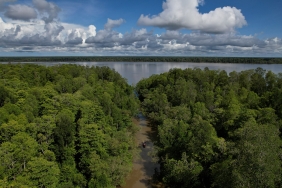
For WWF–Indonesia, nature is both a playground and the best learning environment for children. This is because nature offers experiences that cannot be replaced by a screen. Children learn through the feel of the soil, the sound of birds, the flow of rivers, the shade of trees, and the various living creatures that are part of the ecosystem. From these simple experiences, a sense of wonder, care, and responsibility to protect the Earth grows.
This is increasingly important because children are the group most vulnerable to the impacts of environmental degradation. Climate change, river and ocean pollution caused by plastic waste, the reduction of green open spaces, and the loss of biodiversity will affect their quality of life, both today and in the future. Therefore, building a future for children cannot be separated from efforts to protect the environment where they live, play, and grow.
A sense of environmental care does not arise solely from theory, but from firsthand experience. When children play under the shade of trees, observe birds perched nearby, touch the soil, plant seedlings, or learn to keep rivers and their surroundings clean. Indirectly, they are actually building an emotional connection with nature. It is this connection that forms the foundation for the development of a sense of care and responsibility to protect the Earth in the future.
This spirit forms the basis for various environmental education approaches developed by WWF-Indonesia. Learning takes place not only in the classroom but also through hands-on experiences that encourage children to stay active, explore, and interact with their environment.
Through Panda Mobile, for example, children are introduced to Indonesia’s natural wealth through educational games, discussions, watching films, simple experiments, and creative activities that encourage them to think critically while collaborating. The learning environment is designed to be fun so that children gain real-world experiences, rather than simply receiving information in a one-way manner.

In various regions, a similar approach is also being implemented through the Plastic Smart Cities program in collaboration with schools, teachers, and communities. Children are encouraged to recognize the issue of plastic waste through simple practices such as sorting trash and applying the principles of refuse, reduce, reuse, recycle, and repair (5R), and understanding that small daily habits can have a significant impact on the environment. Children not only learn about the problem but also practice becoming part of the solution.
Meanwhile, in Papua, WWF–Indonesia has established the Holey Narey Learning Center (HNLC), a learning space that integrates science, hands-on experiences, creativity, and conservation values. Here, children learn to recognize the forest as a home for various animals, learn about hydroponics and ecoprinting, read books on environmental themes, and explore the natural and cultural riches of Papua. At Holey Narey, learning goes beyond mere knowledge; it builds experiences, curiosity, and emotional connections that foster a care for the environment from an early age.

WWF-Indonesia also provides educational materials that are more relatable to children, one of which is the educational storybook "Stories for the Earth". Through engaging stories and illustrations, children are guided to understand various environmental issues in a simple and enjoyable way, so that a sense of care for nature can develop from an early age.
We believe that environmental education is a crucial foundation for shaping a generation capable of facing the challenges of the future. When children understand the relationship between humans and nature, they will grow into individuals capable of making wise, responsible decisions and becoming part of the solution for the Earth’s sustainability. Loving the environment is not a burden, but rather a good habit that can begin with simple, everyday actions.
Ultimately, protecting nature is not just about preserving forests, rivers, oceans, or wildlife. Protecting nature also means preserving children’s play spaces. When natural spaces remain preserved, children have places to run, use their imagination, explore, make friends, and learn from real-world experiences that will shape their character as the nation’s future generation.
On the occasion of National Children’s Day 2026, WWF-Indonesia invites parents, teachers, schools, the government, communities, the business sector, and all segments of society to work together to create more opportunities for children to play in nature again, learn from their surroundings, and grow into a generation that loves the Earth. After all, every small step taken today to protect the environment is an investment in the future of Indonesia’s children.
Because children’s futures are inseparable from the future of the environment.
Happy National Children’s Day 2026.
References:
1. Ministry of Communication and Digital Affairs of the Republic of Indonesia. (2026). TUNAS Family Program: Protecting Children from the Dangers of the Digital Space. Retrieved from https://www.komdigi.go.id
2. Ministry of Communication and Digital Affairs of the Republic of Indonesia. (2026). Kemkomdigi Partners with Operators and Digital Platforms to Encourage Children’s Activities in the Real World. Retrieved from https://www.komdigi.go.id