STRENGTHENING REGIONAL COLLABORATION THROUGH THE BISMARCK SOLOMON SEASCAPE SCIENCE HUB - UNIVERSITY PARTNERSHIP WITHIN THE CTI-CFF FRAMEWORK
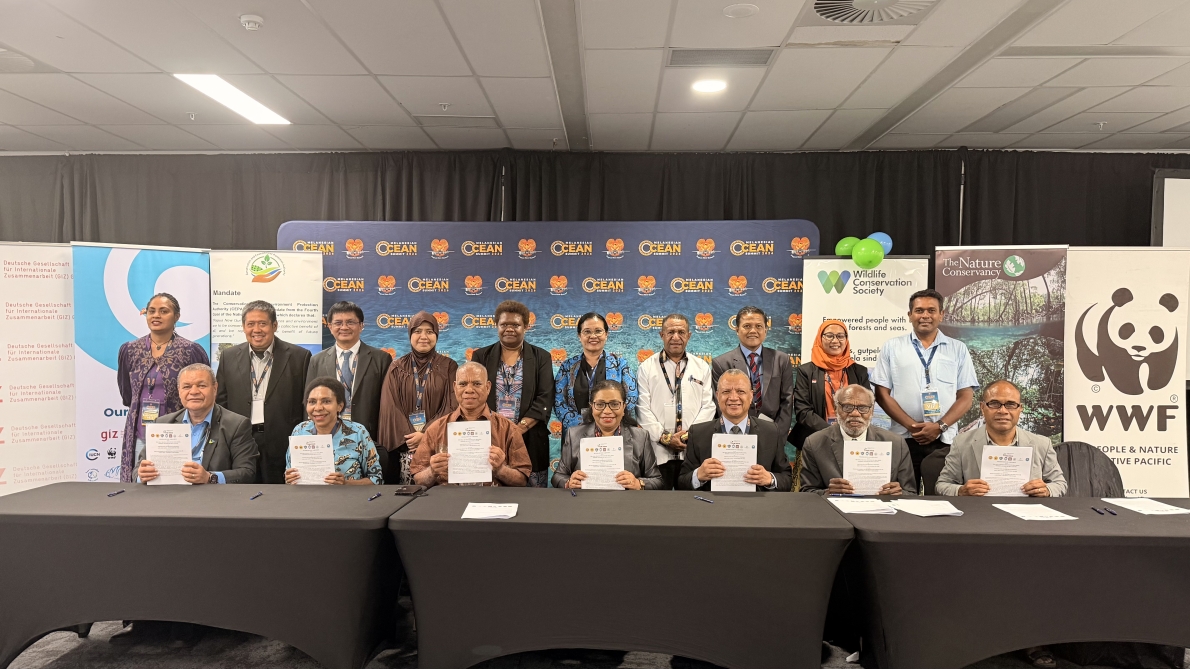
Universities and strategic partners from Indonesia, Papua New Guinea, and Solomon Islands officially strengthened regional cooperation through the signing of a Memorandum of Agreement (MoA). This agreement marks the birth of the Bismarck Solomon Seascape (BSS) Science Hub - University Partnership under the Coral Triangle Initiative on Coral Reefs, Fisheries and Food Security (CTI-CFF) framework.
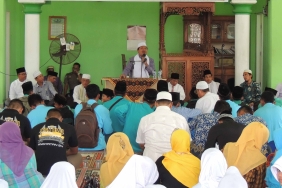
The signing took place during the Melanesian Ocean Summit 2026 at the APEC Haus, Port Moresby, Papua New Guinea on May 14, 2026. The summit was attended by more than 50 representatives from various institutions, including universities, governments, non-governmental organizations (NGOs), research institutions, and regional and international development partners. This agreement reflects the trilateral's strong commitment to advancing science-based collaboration and sustainable marine governance in the Bismarck Solomon region.
Representing the Land of Papua, Indonesia, the University of Papua (UNIPA), the University of Cenderawasih (UNCEN), and the University of Okmin Papua (UOP) are taking an important role in this collaboration. Together with universities from Papua New Guinea and Solomon Islands, the three-country partnership is focused on strengthening coastal and marine research, innovation, human resource capacity building, and science-based public policy development.
The three-country partnership is focused on strengthening coastal and marine research, innovation, human resource capacity building, and science-based public policy development.
This strategic initiative has the full support of the WWF network (WWF-Indonesia, WWF Papua New Guinea, WWF Solomon Islands, and WWF Pacific) and other development partners. In particular, WWF-Indonesia plays an active role in assisting universities and local governments, as well as coordinating intensively with the Ministry of Maritime Affairs and Fisheries (KKP) of the Republic of Indonesia to ensure a smooth development process until the signing of this agreement.
.
Synergy for Sustainable Development A similar commitment was also shown by the Papua Provincial Government and the Pegunungan Bintang Regency Government. This support is a tangible manifestation of efforts to encourage sustainable development that integrates landscapes and seascapes. The involvement of local governments is considered crucial to harmonize development policies, conservation efforts, capacity building of indigenous peoples, and strengthening cross-country cooperation networks in the Pacific and Coral Triangle regions.
Focus of Cooperation: Integration of Science and Local Wisdom The BSS Science Hub cooperation framework includes various strategic programs, including:
- Collaborative research and joint publications.
- Faculty and student exchanges.
- Operation of scientific symposia and field schools.
- Development of knowledge sharing system.
For the future, the Hub is projected to become a platform for collaborative learning and inclusive peer-to-peer learning between academics, indigenous peoples, local communities, NGOs, and environmental conservation practitioners.
Furthermore, this partnership is directed to support strategic government programs and policies at the regional and national levels. The parties believe that sustainable marine governance demands a strong integration of modern science, public policy and traditional ecological wisdom, while placing indigenous peoples and coastal communities at the forefront of guarding marine ecosystems.
Through the signing of this MoA, all parties reaffirm their commitment to advance regional cooperation, biodiversity conservation, climate resilience, and sustainable fisheries management for inclusive development in the Bismarck Solomon Seascape and Coral Triangle region.