WHY SHOULD WE CARE ABOUT THE OPEN OCEAN?
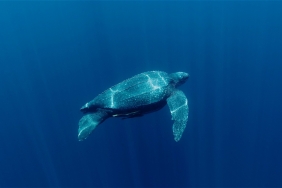
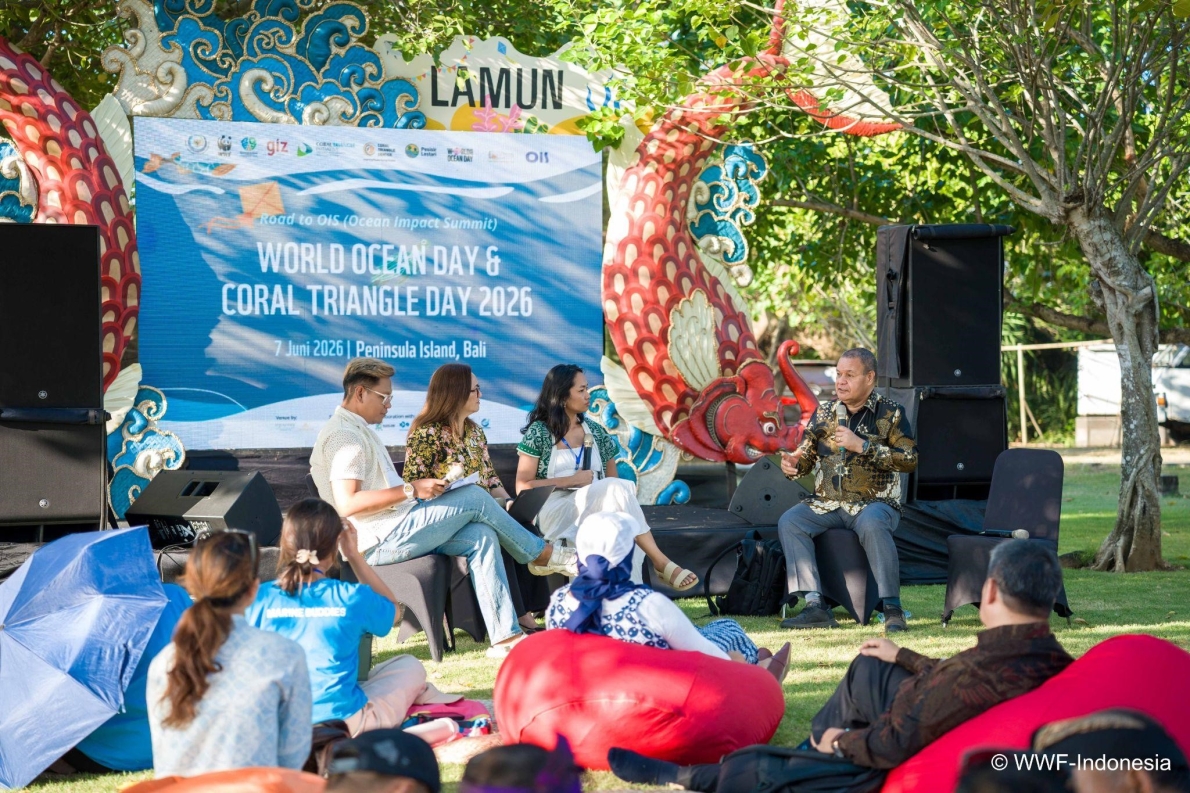
Bali, June 7, 2026: Whale sharks, sea turtles, tuna, and seabirds migrate across the waters of various countries and the high seas throughout their life cycles. Therefore, ocean management does not stop at a country’s territorial boundaries. This issue was discussed in the session “Beyond Borders: High Seas Governance and the Future of Sustainable Oceans,” part of the World Ocean Day & Coral Triangle Day 2026 series initiated by WWF-Indonesia in collaboration with the Ministry of Marine Affairs and Fisheries (KKP).
The session, moderated by Gandabhaskara Saputra, featured Dr. Frank Keith Griffin, Executive Director of the Coral Triangle Initiative on Coral Reefs, Fisheries, and Food Security (CTI-CFF) Regional Secretariat; Febryani Sabatira, Legal Researcher at the Indonesian Ocean Justice Initiative (IOJI); and Mareska Mantik, Marine Advisor at GIZ Indonesia & ASEAN.
One of the main topics discussed was Biodiversity Beyond National Jurisdiction (BBNJ), an international treaty governing the conservation and use of biodiversity in the high seas. Mareska Mantik explained that Indonesia ratified the agreement in June 2025, and the BBNJ officially entered into force on January 17, 2026, after meeting the required minimum number of ratifications.
The BBNJ is structured around four main pillars. The first pillar governs the use of marine genetic resources (MGR) and the fairer sharing of benefits. The second pillar focuses on area-based management tools (ABMT), including marine protected areas. The third pillar addresses environmental impact assessments, while the fourth pillar promotes capacity building and the transfer of marine technology to developing countries.
Through the Living High Seas project, GIZ, together with the government and various international partners, is supporting the development of area-based management tools as part of the BBNJ’s implementation. Indonesia is one of the countries receiving assistance in developing these instruments, particularly under the ABMT pillar.
Dr. Griffin explained that ocean management cannot be carried out in isolation by individual countries. The CTI-CFF, which involves six countries in the Coral Triangle region, has long fostered cooperation to maintain the connectivity of marine ecosystems while supporting community food security.
“The ocean does not separate us; it connects us,” said Griffin.
According to him, fish and various marine species move across national borders, so protecting biodiversity requires coordination that transcends national jurisdictions. In this context, the BBNJ serves as a framework that can strengthen collaboration among nations in the management of the high seas.
The discussion then turned to the impact of the BBNJ on Indonesian communities. Febryani Sabatira explained that the conservation of high seas biodiversity is closely linked to the lives of coastal communities and indigenous peoples. The provisions of the BBNJ open up greater opportunities for recognizing the rights of communities with ties to marine resources.
Regarding marine genetic resources, indigenous and local communities have the right to determine how their traditional knowledge may be accessed and utilized. In area-based management frameworks, affected communities also have the right to be consulted. Meanwhile, during the environmental impact assessment process, communities have the right to receive information and provide input on activities that could potentially affect marine biodiversity and coastal areas.
The discussion also highlighted the existence of approximately 82 million hectares of coastal areas in Indonesia inhabited by more than 200 indigenous and local communities. Therefore, the implementation of the BBNJ is not only related to the governance of the high seas but also concerns the recognition and protection of the rights of communities whose livelihoods depend on marine resources.
Through this session, the speakers demonstrated that the high seas are not an issue far removed from people’s daily lives. The state of biodiversity in the high seas, the management of marine resources, and decisions made through international cooperation can have an impact all the way to coastal areas. Therefore, protecting the high seas is not only the responsibility of the countries involved in international agreements but also part of the effort to ensure the sustainability of marine resources that sustain the lives of many people.