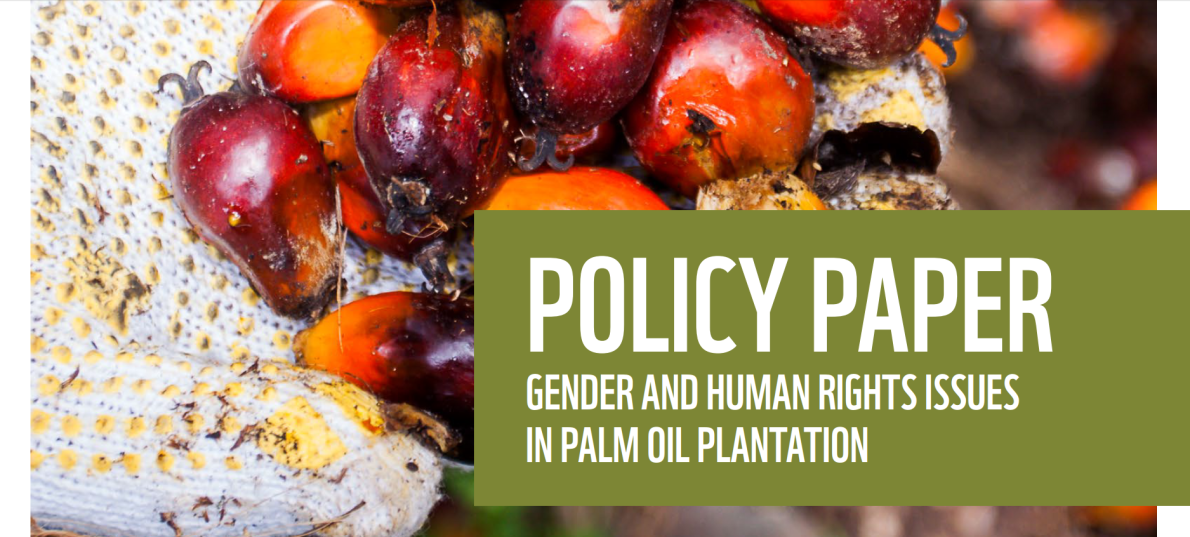
POLICY PAPER: GENDER AND HUMAN RIGHTS ISSUES IN PALM OIL PLANTATION
Women are the most vulnerable to exploitation in the oil palm plantation sector. They are at risk of being discriminated against, both in the system of working relations with oil palm plantations, as well as access to women’s human rights, such as the right to health. The pattern of relationships between women workers and the company has never been good.
It is difficult for women workers or women living in oil palm concessions to obtain health rights, such as reproductive health. It is well understood that women’s reproductive rights are essential rights that must be obtained by all women, without any discrimination.
Globally, the recognition of women’s rights has been regulated in the 1979 Convention on the Elimination of All Forms of Discrimination against Women (CEDAW). CEDAW is the culmination of global efforts to protect and promote women’s rights. At the national level, Indonesia has ratified CEDAW in 1984.
In addition, various instruments to protect women’s rights have also been issued by the Indonesian government, both in the form of regulations and policies. Meanwhile, in the micro context, certification systems for sustainable palm oil plantations, such as the Indonesian Sustainable Palm Oil (ISPO) and the Roundtable on Sustainable Palm Oil (RSPO) also regulate the protection of women’s rights in the oil palm plantation sector.
However, all of the existing instruments have not yet achieved optimal protection for women. Discriminatory practices and violence against women in the oil palm plantation sector still occur today.
This study found that massive discrimination and violence against women occurred because of the poor management system of oil palm plantations. Issuing licenses for oil palm plantations in areas that are difficult to access by the community is a major factor in the emergence of discrimination and violence against women. Such difficulty of access causes the monitoring system to not work well.
In fact, areas that are centers of oil palm plantations have a low Gender Development Index (GDI) and Gender Empowerment Index (GEI) score. Even though these regions already have policies on women’s protection, such as regional action plans in achieving the Sustainable Development Goals and regional action plans in gender mainstreaming.
The monitoring system is impaired by investment practices carried out by companies that do not adopt regulations and policies to protect women. The certification system for sustainable palm oil plantations is also not optimal at the micro level to encourage improvements in the protection of women.
Therefore, improvements are needed in suppressing the practice of discrimination and violence against women in the oil palm plantation sector.