BEFORE BUILDING MORE CONCRETE STRUCTURES, WE MUST FIRST RESTORE NATURE
Scientists have long warned that climate change and the depletion of natural resources will converge at a single crisis point. Both of these problems stem from human actions—ranging from activities that contribute to the accumulation of greenhouse gas emissions in the atmosphere to the erosion of natural ecosystems in the name of short-term development.
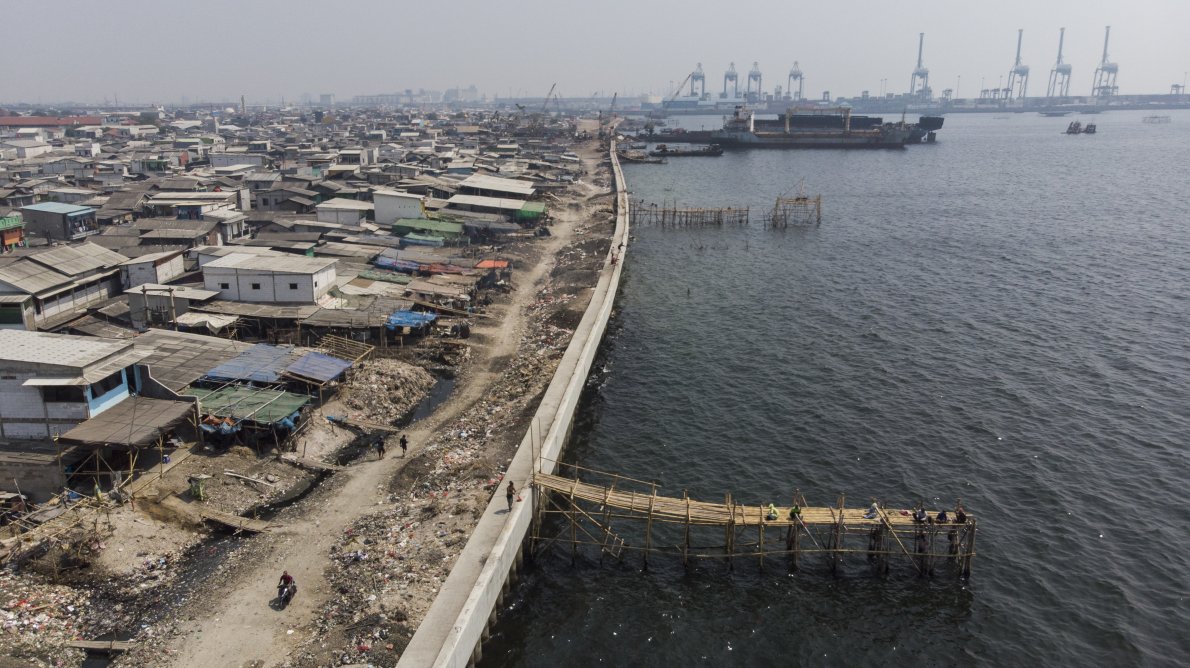
What scientists have been warning us about, we are now experiencing firsthand. On the northern coast of Java, the impacts are palpable in two forms that occur simultaneously: a clean water crisis and increasingly frequent tidal flooding that submerges homes, rice fields, and roads.
We cannot overlook the data on environmental degradation. The World Bank has recorded the rate of land subsidence (land subsidence) in Jakarta at 7.5–10 cm per year, with certain areas in North Jakarta reaching 15–25 cm annually. Research by the National Research and Innovation Agency (BRIN) on cities along the North Coast (Pantura) found variations in the rate of subsidence between cities. Pekalongan was recorded as having the highest rate, reaching 12 cm per year.
Meanwhile, the National Capital Integrated Coastal Development (NCICD, 2014) document projects a relative sea-level rise of up to 3–5 meters by 2050 (based on an accumulated global sea-level rise of approximately 8 mm per year). Local land subsidence ranges from 7–14 cm per year. BRIN has designated the Pantura region (Serang–Situbondo) as a national crisis. This is because 65.8% of this region’s coastline has already experienced erosion. This fact is not merely a local environmental issue, given the Pantura region’s role as the economic backbone of Java. In addition to data on environmental damage, studies on economic losses reveal staggering figures. Gadjah Mada University modeled the impact of tidal flooding on buildings in North Semarang, estimating losses ranging from Rp101 billion to Rp2.1 trillion.
Concrete as an Instant Solution
Facing a national crisis, several parties are pushing for large-scale technological solutions. Two solutions are frequently touted: the Giant Sea Wall (GSW) and seawater desalination. The government projects that this concrete structure will stretch over 500 km (Banten–Gresik). Estimated costs continue to fluctuate as plans mature—ranging from Rp600–700 trillion, then Rp809 trillion, to the latest projection of between Rp1,280–1,297 trillion. These fluctuations depend on the specific scheme and scope being considered. In Jakarta, discussions about desalination are directly linked to the construction of the Giant Sea Wall.
Of course, given these construction cost estimates, we must consider that the Giant Sea Wall and desalination are expensive technologies with hidden costs that are rarely fully accounted for. These costs arise from various activities, such as the energy required for the desalination process, the treatment of raw water that is already contaminated prior to desalination, and the discharge of salty process wastewater (brine) into the marine ecosystem. Not to mention the risk of a massive pool of pollutants forming behind the seawall if the rivers flowing into it are not first properly managed. However, this does not mean that such infrastructure is an inappropriate solution.
Nature Restoration: A Priority for Infrastructure Development
Is there another way to address the national crisis in Java’s Northern Coast (Pantura)?
Tidal flooding and the clean water crisis are not the result of a single cause. Both problems result from a complex interplay of factors, including climate change-driven sea-level rise, land subsidence, changes in land use both upstream and downstream, hydrological changes caused by river normalization, and the degradation of coastal ecosystems.
Although reducing greenhouse gas emissions remains a top priority, climate change operates by amplifying other factors that are entirely within human control. We must have the right strategies for managing groundwater, planning land use in upstream river areas, and managing coastal ecosystems and shallow waters. Since control lies in our own hands, it is only fitting that we need not wait for a global climate agreement.
The government itself acknowledges the complexity of the national crisis in the North Coast of Java. Some time ago, Coordinating Minister for Infrastructure and Regional Development Agus Harimurti Yudhoyono emphasized that the construction of coastal dikes, sea walls, and river normalization is “a massive undertaking from upstream to downstream.” Preventing tidal flooding and land subsidence requires more than just building dikes; it also necessitates curbing groundwater exploitation and managing land use in the upstream areas first. For the rest, he cited nature-based solutions—particularly mangrove restoration—as the most effective approach that can be implemented more quickly.
Logically, the answer lies in restoring nature and damaged ecosystems: restoring watersheds in the upstream areas, restoring infiltration zones in the downstream areas, restoring river ecosystems, renaturalizing river bends that have been straightened, and restoring mangrove ecosystems. The goal is simple. We want to restore nature’s capacity to provide environmental services: absorbing rainwater, replenishing groundwater reserves, mitigating floods, and protecting coastlines from erosion.
Empirical evidence is beginning to accumulate, although most of it comes from contexts different from the Pantura region of Java. The report Nature-Based Solutions in the UK published by WWFin 2025 documents natural flood management interventions (natural flood management), including the reconnection of floodplains, the construction of small wooden dams (leaky dams), and wetland restoration. These activities were carried out at three pilot sites in the Norfolk watershed, England. As a result, these interventions have yielded a benefit-to-cost ratio ranging from 11 to 21 times. In this case study, the calculations specifically stem from flood losses that were successfully avoided, excluding additional benefits such as improved water quality and groundwater recharge.
This case study is certainly no guarantee that similar results will occur in the Pantura region of Java. However, we can wisely conclude that nature-based interventions, if carefully designed and evaluated according to the local context, can provide economic value that is competitive with hard infrastructure. It is important to note that each location still requires its own feasibility study (site-specific assessment), including an analysis of long-term maintenance costs.
Both the Giant Sea Wall and ecosystem restoration have the potential to cause social impacts if designed without considering who is actually affected. Four questions must always be asked regarding any intervention option: Who is being protected? Who bears the risk if the intervention fails or is delayed? Who loses access (to the sea, aquaculture ponds, fishing routes, or water sources) as a result of this project? And who is truly involved in the decision-making process?
Prioritizing Solutions
The real question isn’t simply whether the Giant Sea Wall along Java’s northern coast is necessary. Rather, the question is the sequence of interventions. Logically, the approach should start with addressing the root causes and move toward residual risks that truly cannot be managed by other means: reducing groundwater extraction, expanding the piped water network, restoring rivers, watersheds, and mangrove ecosystems, and optimizing raw water sources, and only then should hard solutions such as seawalls and polders be considered at truly critical points.
Nature-based Solutions (NbS) must be prioritized in this sequence of interventions—not as a substitute for hard infrastructure, but as a foundation that reduces the need for hard infrastructure in the future and makes it more targeted. The crisis we face today is, in fact, multifaceted: climate change interacting with groundwater exploitation, land-use change, and the degradation of coastal ecosystems. All of these are triggered by human activities. Therefore, the solution must also be multi-layered—ranging from reducing emissions and managing groundwater to restoring ecosystems simultaneously. We must also consider who benefits and who bears the burden of every decision made.
Ultimately, the question is no longer “nature or concrete.” Nature must be treated as an equal component of national resilience infrastructure. This is just as serious as levees in budget planning, and its social and environmental impacts must be assessed with equal rigor. Healthy ecosystems—restored and managed through inclusive governance—are a long-term investment that reduces the risk of having to pay dearly twice over.