GLOBAL ELEPHANT DAY 2026: PRESERVING HABITATS, PROTECTING THE SURVIVAL OF SUMATRAN ELEPHANTS THROUGH COLLABORATION
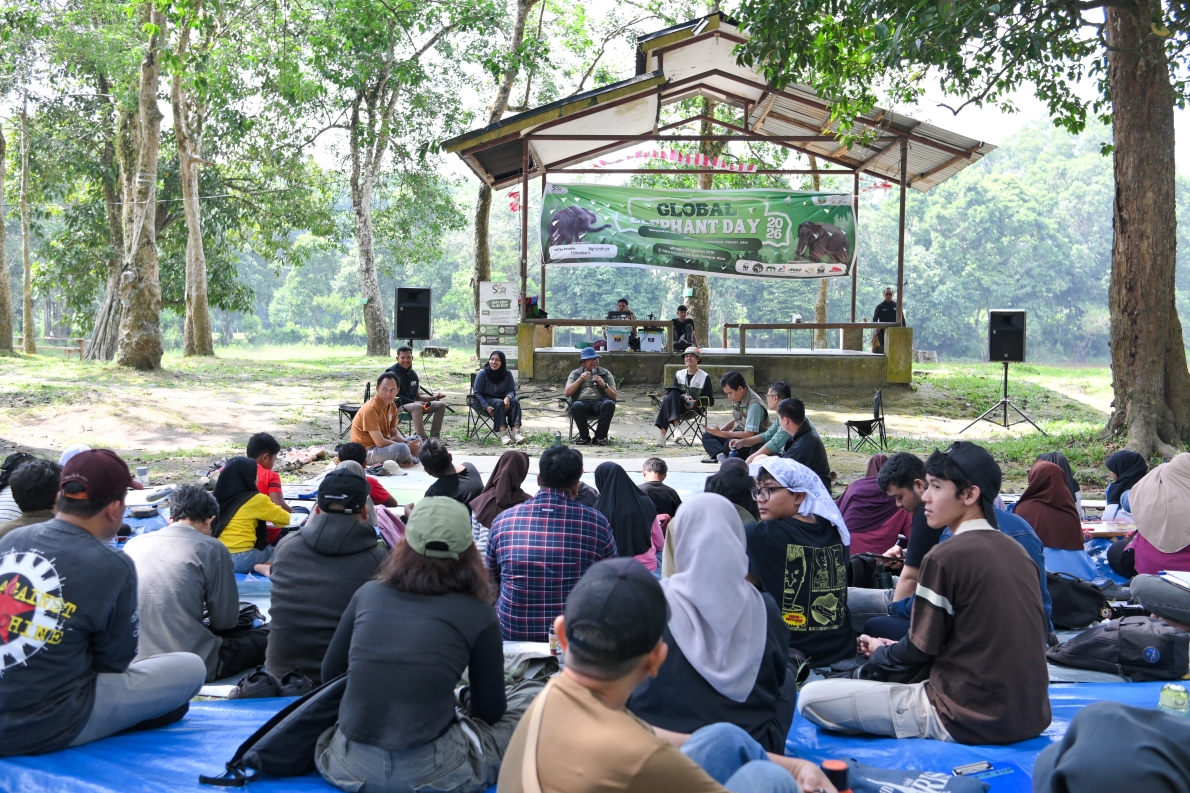
Stories about elephants and messages about the importance of preserving forests came together during the 2026 Global Elephant Day (GED) celebration at the Buluh Cina Nature Tourism Park (TWA) in Riau. In a space that brought together the public, the arts community, village officials, and conservation advocates, the cause of protecting Sumatran elephants was championed in a more relatable and creative way. Sobat Gajah Riau, together with WWF-Indonesia, the Riau Natural Resources Conservation Agency (BBKSDA Riau), the arts community, village governments, and the public, organized a series of campaigns that combined education, art, literacy, and conservation actions to foster concern for elephants and their habitats.
Various activities—such as planting elephant feed, “Elephant Talks,” “Sketch On The Spot,” the “Elephant Zine” workshop, and “Melodies for Elephants”—were creatively designed to make conservation messages more accessible to diverse audiences. GED also highlights the importance of collaboration between communities, the government, artists, and the public. Through this collaboration, conservation becomes not just the responsibility of a single party, but a collective movement to sustainably raise awareness about the Sumatran elephant and its habitat.
The Sumatran elephant (Elephas maximus sumatranus) is one of Indonesia’s iconic animals that plays a vital role in maintaining the balance of forest ecosystems. Their movements aid in forest regeneration and seed dispersal, and their presence supports the survival of various other animals and plants. The presence of elephants in an area can serve as an indicator that the resources needed by other wildlife are still available.
Elephants are animals that require vast roaming areas, as well as sufficient food and water to sustain their lives. The head of the Riau Natural Resources Conservation Agency (BKSDA), Supartono, stated that elephant movements highlight the importance of preserving their habitats and migration routes. “When an elephant walks, it never turns back, so its direction of movement is always forward, and it follows the same migration route every year,” he said.
A study by Muhammad Ali Imron explains that thirty-two percent—or 135,646 km2—of Sumatra’s land area is predicted to be suitable elephant habitat. In his explanation, Supartono also mentioned that “there are three important corridors for elephant movement in Riau that need to be jointly managed: the Tesso-Taranegra Corridor, the Tahura Corridor, and the Balai Raja Corridor.” These three corridors play a vital role in maintaining the connectivity of elephant ranges.
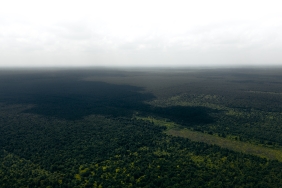
However, the Sumatran elephant population is now facing increasing pressure. Classified as “Critically Endangered” (Critically Endangered) by the IUCN, these animals face threats such as poaching, illegal trade, and habitat loss and fragmentation due to the conversion of forests into plantations and residential areas. These conditions have a direct impact on elephant populations and their ranges. The reduction and fragmentation of forests can split elephant populations into smaller groups. As a result, elephant habitats come into closer proximity with human activity areas, thereby increasing the potential for human-elephant conflict.
Education and Literacy to Get to Know Elephants Better
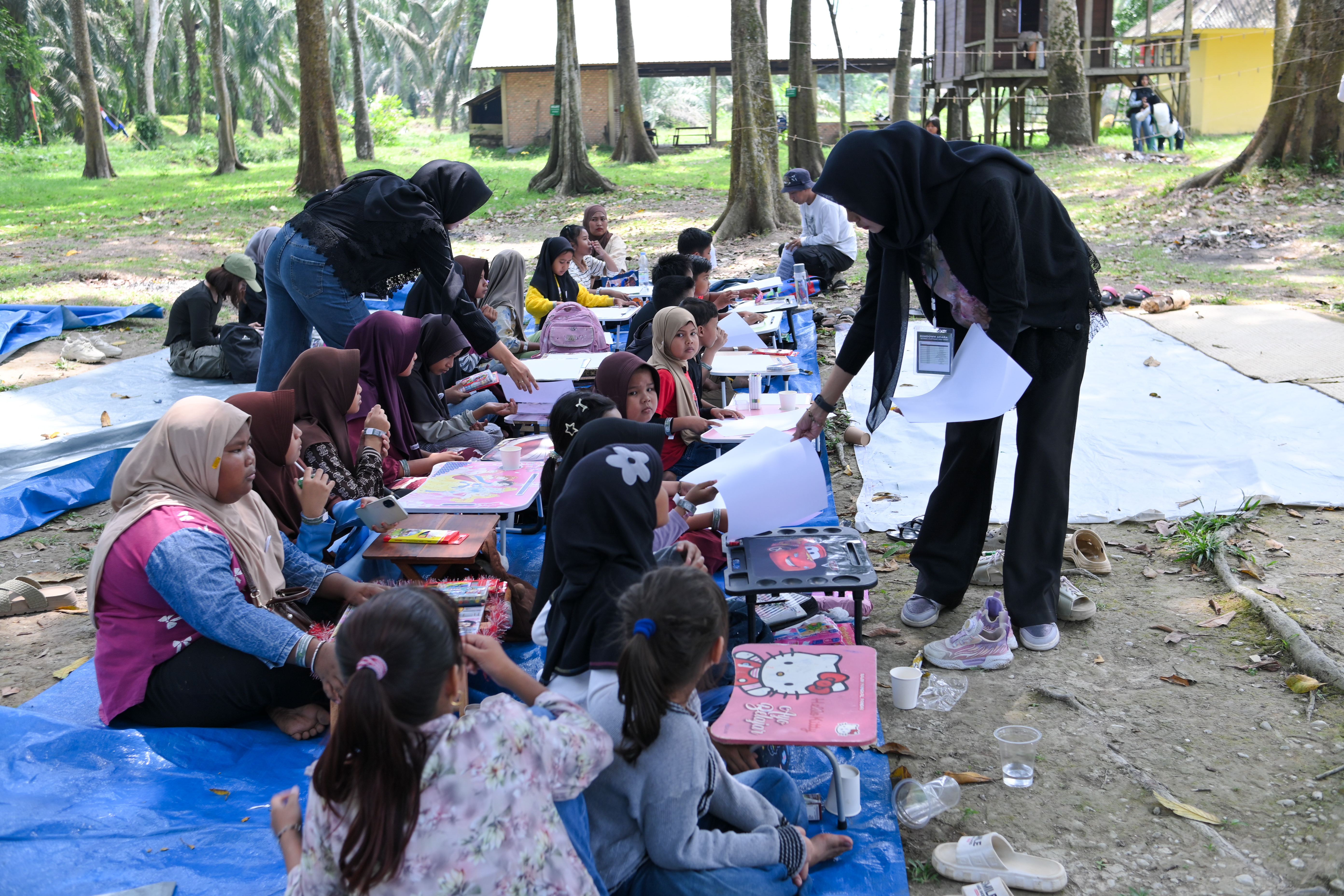
For Riau Elephant Friends, raising public awareness about the existence of elephants is one of the first steps in fostering a sense of care for conservation. The presence of three elephants in the Buluh Cina Wildlife Reserve—a male, a female, and a calf—is considered to have great potential as an educational resource. The public can learn firsthand about the lives and development of elephants, while also becoming familiar with the Buluh Cina Wildlife Reserve, an area previously little known as a habitat for elephants. Non Blok also conducts educational activities through nature-based learning sessions with children. During these sessions, children are introduced to various facts and information about elephants. The learning process involves not only listening but also observing, reading, writing, and drawing. Throughout the activity, the children appeared enthusiastic and eager to interact.
Through this approach, children gain firsthand experience observing and interacting with elephants. This interactive and creative educational approach is expected to help children retain what they’ve learned about elephants more easily. Education serves as the first step toward fostering public awareness, particularly among children. The more people learn about elephants and understand their existence, the greater the opportunity to raise awareness about the importance of protecting these animals and their habitats.
Art as a Language to Advocate for Elephants
In addition to education, art is also one of the approaches used to advocate for elephant conservation. During Global Elephant Day 2026, music and visual art were used to convey conservation messages to the public in more creative ways. Musician Ibnu Syam views music as a medium with the power to influence how people remember and understand a message. Melodies and lyrics can linger in listeners’ minds, making music a space to convey messages about caring for the environment and wildlife. Ibnu performed a song specifically composed about elephants during the Global Elephant Day 2026 event. The various facts learned about the threats facing elephants served as inspiration for creating this piece. Through music, the message about the importance of coexisting with all forms of life was conveyed to the public.
The Sketsa Gembira community also carried out this approach through on-site sketching activities in nature. For the participants, this activity is not merely about producing artwork, but also an opportunity to get to know the environment and elephants more closely. Through music and visual art, conservation messages are conveyed in a way that resonates more closely with people’s experiences and emotions, thereby reaching the public through a creative and accessible language.
Village Regulations and the Community’s Role in Protecting Nature
The excitement surrounding Global Elephant Day (GED) 2026 at the Buluh Cina TWA also stemmed from the involvement of the local community. The Buluh Cina Village Government and residents supported the event, from providing refreshments to assisting children with coloring activities featuring Sumatran elephants. This involvement demonstrates that conservation is not merely the result of campaign activities but is also an integral part of daily life for communities living near the area.
The Buluh Cina Village Government had previously demonstrated this commitment through a village regulation (Perdes) governing environmental management. This regulation prohibits indiscriminate deforestation as well as the use of poison and electric shocks for fishing. These village-level regulations represent one of the community’s efforts to protect the area and the natural resources that sustain their livelihoods.
For Sumatran elephants, protecting their habitat means safeguarding the sustainability of an ecosystem that also serves as a living space for humans. Therefore, education, creativity, community involvement, and local policies must go hand in hand. These efforts are increasingly important so that elephant conservation does not remain merely a message in a warning, but grows into an awareness and practice that continues from one generation to the next.
“Elephant conservation requires multi-stakeholder and multigenerational collaboration, because this species is part of human life. Ensuring its survival means providing hope for a better quality of life for future generations,” said Beno Fariza Syahri, Project Leader & Wildlife Biologist at WWF-Indonesia.
That spirit of collaboration is a vital part of the 2026 GED commemoration at the Buluh Cina TWA—bringing together art, education, communities, and conservation in a single effort to protect the Sumatran elephant and its habitat.