JUST ENERGY TRANSITION TOWARDS THE 2045 GOLDEN INDONESIA VISION
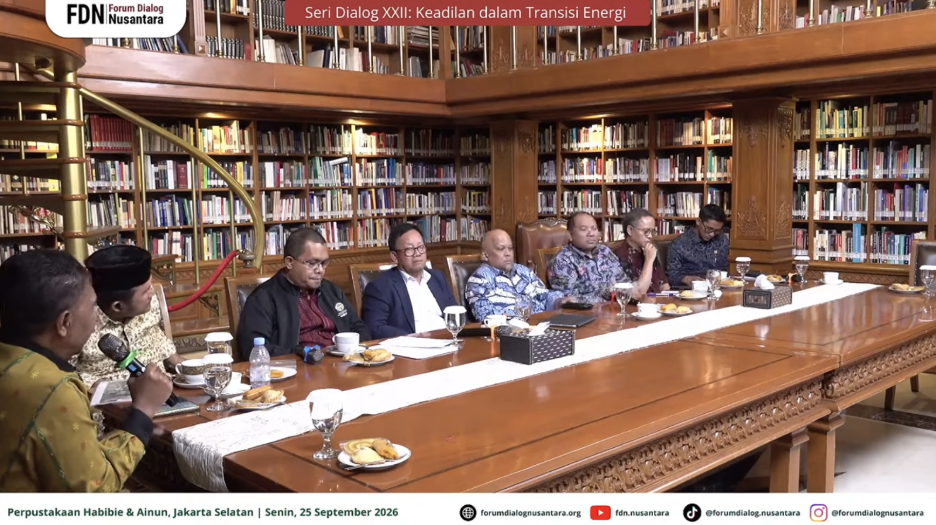
On Friday, 25 September 2026, Forum Dialog Nusantara (FDN), a strategic think tank focused on addressing critical national issues, invited various stakeholders representing perspectives on energy security, social justice, and public policy governance to a panel discussion at the Habibie & Ainun Library. The discussion examined the urgency of accelerating Indonesia’s renewable energy transition (RET) as climate change increasingly threatens Indonesia’s environment, economy, and communities. This includes challenges related to supply reliability, affordable energy prices for the public, and social and environmental dynamics at the local level. Overall, the discussion aims to a) prevent a green oligarchy so that and energy prices stay affordable for the public, b) seeks concrete solutions to rotating power outages and the impacts of rising fuel prices, c) examine the geothermal controversy through the lens of environmental governance and local community participation, and d) strengthen the oversight role of Parliament and DEN in developing fair and transparent RET regulations.
At the FDN panel discussion, Dr. Ing. Ilham Akbar Habibie, Co-Founder and Chair of the Advisory Board of FDN, opened it with the need to avoid green oligarchy amid the increasing presence of green jobs as we transition to a more sustainable future. Although market mechanisms are important, it is also essential to ensure that the economic benefits of the green transition are distributed more broadly, and energy prices stay affordable for the public. This would then empower villages and rural communities, as they would also have the opportunities to participate directly in the green economy. For example, villages could develop community-based solar projects and other green activities, create local jobs, and strengthen the livelihoods of their community.
With the NZE target by 2050, developments still continue requiring significant amounts of energy. It is a critical issue as the national energy mix is 85% fossil fuel and only 15% is sourced from renewable energy. Moreover, the nation is still having to import 1.2 million barrels of fuel daily to fulfill the oil demand as the consumption only reaches approximately 1.62 million barrels of fuel per day. Consequently, the country is exposed to price shocks and the risk of an energy deficit. Indonesia needs to prioritize and accelerate energy transition seriously to also prevent power outages and rising fossil fuel prices. There are a few solutions including the use of geothermal, being at the ring of fire, solar panels, lies at the equator, wind, and supported by Battery Energy Storage and System (BESS) would significantly enhance grid stability. Overall, it could prevent removing grid barriers that keep renewables out, including PLN's monopoly, unresolved subsidy and compensation issues, and weak governance.
Research institutions now record a temperature rise of about 1.4°C, close to the 1.5°C limit considered safest for vulnerable communities and ecosystems, and the effects of sea level rise are irreversible. Many cities and districts have also made low-carbon commitments, but the state budget cannot close the climate finance gap alone. On that event, Ari Mochamad, Leader of Climate WWF Indonesia, emphasized that stakeholders must not only make commitments but to implement and carry them out. For example, for example, PLN can utilize the Taskforce on Nature-related Financial Disclosures (TNFD) framework as an instrument to assess and manage nature-related risks, dependencies, impacts, and opportunities across its overall business operations and governance. Applying to the TNFD framework at the institutional level can help PLN identify and integrate nature-related considerations into its decision-making, risk management, and business planning. The approach can subsequently be applied more specifically to individual activities or projects, including geothermal, hydropower, transmission, or other energy infrastructure, to identify site-specific nature-related risks and strengthen appropriate safeguards. This means that they are aware that the operational energy infrastructure depends on the condition of the natural environment, including local ecosystems and biodiversity, as well as the affected communities. It also means involving communities meaningfully from the earliest planning stage, because projects that exclude them have led to conflict and investor losses.
Despite Indonesia being the 2nd in the world with the highest geothermal potential (23 GW), only 2.78 GW or 11.6% of it has been utilized. It is also one of the renewable energies that is a baseload power source as it is a continuous, reliable, and stable supply of electricity 24/7. According to Dr. Suroso Isnandar, Director of Project Management and New & Renewable Energy (EBT) at PT PLN (Persero), PT PLN's Kamojang geothermal site, one of Indonesia's earliest geothermal exploration sites, has operated for 43 years and has run at about 90% of capacity over the past three years. This shows geothermal can be stable and reliable, with the hope that it can continue operating for the next decade. PLN now aims to expand 19 of their geothermal power plants across regions from Sumatra and Java to East Nusa Tenggara (NTT) and beyond.
In the next three years, Indonesia has planned to add 5.2 GW of geothermal in the next decade's Rencana Usaha Penyediaan Tenaga Listrik (RUPTL), which leads to being the world leader in geothermal capacity. However, there are barriers to land, licensing policy, and operational risks. To address them, regulations are being revised, and communication channels are being built with local stakeholders, including the Central Java Provincial Government and Semarang Regency. Additionally, nine strategic policies are being implemented for optimization, focusing on key areas like managing dynamics and capacity building. With geothermal capacity growing about 6.7% from 2021 to 2025 and targeted to grow roughly threefold over the next five years, these regulatory changes need to be closely monitored.
In addition, according to Irwanto Wahyu Kusumo, Executive Vice President for Project Development, Loans, and Licensing at PT PLN, overcoming them requires more than CSR, so a dedicated engineering and sustainability directorate is planned to limit risks, monitor sustainability, and safeguard affected communities. This matters because drilling risks (H2S exposure, well blowouts), environmental concerns (river water use, groundwater, seismic activity), and construction risks (erosion, landslides, damage to cultural heritage sites, farmland, and ecosystems) have all been anticipated and are considered manageable, with multiple stakeholders providing oversight. Geothermal also brings direct benefits, as leftover steam can be used for products such as palm sugar and coffee. This is important as there needs to be incentives for the local community to have a sustainable, secure, and stable livelihood.
Emanuel Melkiades Laka Lena, Governor of NTT, mentioned that the province has significant potential across almost all major renewable energy sources. This includes geothermal potential (369 GW) in NTT reaching more than three times the national target (100GW), demonstrating that successful development is possible. However, investors are still reluctant to invest in NTT due to concerns surrounding geothermal projects and the complex dynamics among local stakeholders, including communities and religious leaders. As a result, investors tend to prefer regions where stakeholder acceptance and investment conditions are more favorable.
In conclusion, the urgency of accelerating Indonesia’s RET comes with plenty of challenges, requiring addressing four key purposes. First, preventing green oligarchy will empower villages and rural communities and keep energy prices affordable. Second, geothermal stable baseload power offers a concrete solution to power outages and rising fossil fuel prices. Third, the geothermal controversy must be resolved through strong safeguard, environmental governance, and early, meaningful community participation that secures local livelihoods. Lastly, stronger oversight by the government is needed to ensure RET regulations are fair, transparent, and effective.


