WWF-INDONESIA AND CPOPC AGREE ON COLLABORATION TO STRENGTHEN SUPPLY CHAIN TRANSPARENCY FOR SUSTAINABLE COMMODITIES IN THE GLOBAL MARKET
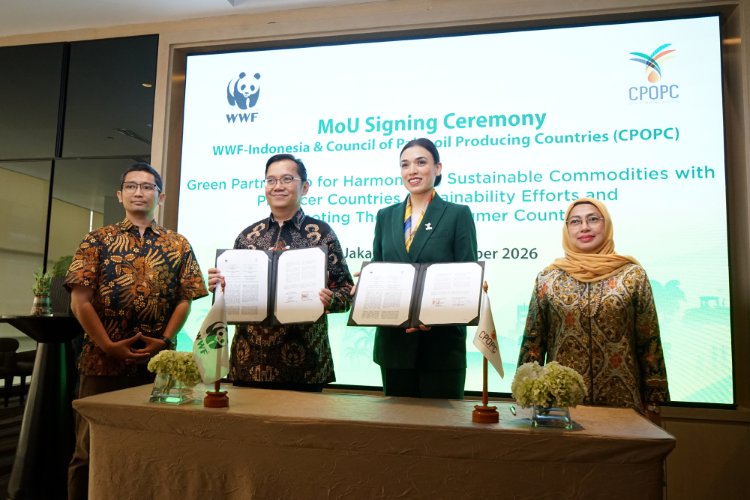
Jakarta, 18 September 2026 – WWF-Indonesia and the Council of Palm Oil Producing Countries (CPOPC) signed a Memorandum of Understanding (MoU) today, at Pullman Thamrin Jakarta, marking the beginning of a strategic partnership to strengthen sustainable commodity systems and enhance their recognition in the global market.
Under the tagline of "Green Partnership", the collaboration aims to strengthen the sustainability system for plantation commodities at both national and global levels, with particular focus on supply chain transparency, certification, responsible production, biodiversity conservation, and the inclusion of independent smallholders in sustainable and responsible supply chains.
CPOPC advocates for stronger sustainability practices and governance across its member countries, while WWF-Indonesia contributes its expertise and knowledge to support the development and the strengthening of supply chain transparency, certification, and responsible production.
Sustainable commodities are a crucial principle in the conservation of biodiversity, particularly in habitat protection, sustainable production landscapes, commodity production practices that take environmental and social aspects into account, and the creation of positive impacts on the economy. One example of these efforts is the Indonesian Sustainable Palm Oil (ISPO) certification. WWF-Indonesia and CPOPC consider that this sustainability standard needs to be strengthened within the global sustainability framework, so as to enhance its credibility and competitiveness in the world commodity market.
Aditya Bayunanda, the CEO of WWF-Indonesia, said, "Establishing the credibility of sustainable plantation commodities requires collaboration among producing countries, including business actors, certification bodies, civil society, independent smallholders, and the global market. For us, sustainable plantation commodities are not merely a supply chain issue, but an effort to safeguard Indonesia's biodiversity. For us, this collaboration is crucial to advancing commodity sustainability in both consuming and producing countries, as well as in terms of supply chain transparency and support for smallholders." Aditya continued, "The credibility of these plantation commodities can be realised by ensuring that they are produced without sacrificing forests, biodiversity, or the rights and livelihoods of independent smallholders. We see a gap between certified production capacity and acceptance in the global market. The collaboration with CPOPC will strengthen ISPO and other national certification schemes developed by producing countries, so that they are accepted in the global market."
Izzana Salleh, Secretary-General of CPOPC, emphasised, "Palm oil producing countries and industry stakeholders have made substantial investments and demonstrated significant progress in strengthening sustainability practices, protecting human rights, and improving livelihoods across the supply chain. National sustainability certification schemes, including ISPO and Malaysian Sustainable Palm Oil (MSPO), reflect the strong commitment of producing countries to advancing sustainability. Nevertheless, we recognise that further progress is needed, particularly in ensuring that smallholders have the necessary resources, capacity, and opportunities to participate fully in sustainable supply chains. This is precisely why partnerships such as the one we are formalising today with WWF-Indonesia are so important. By combining our respective expertise, experience, and networks, we can translate our shared commitments into meaningful and inclusive action," Izzana added.
As a follow-up to the MoU signing, WWF-Indonesia, CPOPC, and Competere jointly conducted a webinar "Leave No Smallholder Behind: Making EUDR Compliance an Opportunity for Inclusive Development". The webinar discussed the implications of the EUDR for palm oil smallholders, including challenges related to geolocation, traceability, and documentation. These requirements can present significant structural challenges for smallholders seeking to maintain access to global supply chains.
The first session, moderated by Samuel Pablo Pareira of WWF-Indonesia, brought together smallholder representatives from Indonesia and Malaysia, namely Rukaiyah Rafik of Fortasbi Indonesia and Muhammad Shofi Bin Mustapa of NASH Malaysia, to share their experiences and perspectives on sustainability and compliance requirements. The second session, moderated by Pietro Paganini of Competere, examined the support systems required to facilitate a transition towards a sustainable palm oil supply chain that remains inclusive of smallholders. The discussion featured perspectives from civil society organizations and industry stakeholders, including Michel Riemersma of Solidaridad Europe, Emily Meijaard of Borneo Futures, Djono Albar Burhan, Representative of Indonesian Smallholders, and Francesco Tramontin of Ferrero.
Through this partnership, WWF-Indonesia seeks to contribute to the transition of plantation commodity supply chains towards production systems that are free from deforestation and illegal land conversion, while supporting Indonesia's efforts to maintain the integrity of its forest ecosystems. Such efforts are essential to conserving biodiversity and reducing environmental risks, including floods and forest fires, which have significant impacts on local communities and protected wildlife. They also include encouraging demand for environmentally responsible and eco-labelled products through the "Beli yang Baik" (Buy Well) campaign, as well as the development of a traceability system through the Hamurni application. The partnership further contributes to Indonesia's broader climate and environmental objectives, namely Indonesia's Second Nationally Determined Contribution (NDC) target to reduce greenhouse gas emissions by 31.89% by 2030 through domestic efforts and up to 43.20% with international support.
For CPOPC, the collaboration represents an important step towards strengthening the role of producing countries in shaping practical, science-based, and inclusive sustainability solutions. At the heart of these efforts is the shared commitment of palm oil producing countries to ensuring that smallholders are not left behind but instead are empowered to participate meaningfully in the transition towards a more sustainable, globally recognised supply chain. CPOPC also recognises and appreciates the substantial efforts and investments made by the palm oil industry in preparing for the implementation of the European Union Deforestation Regulation (EUDR). These efforts underscore the importance of collaboration among producing countries, industry stakeholders, civil society, and international partners to ensure that sustainability requirements are implemented in a practical and inclusive manner, particularly for smallholders whose livelihoods depend on continued access to global markets.
--End--
About WWF-Indonesia
WWF-Indonesia is an Indonesian legal entity and civil society organization working in nature conservation and sustainable development, supported by more than 100,000 supporters. WWF-Indonesia’s mission is to stop environmental degradation and build a future where people live in harmony with nature through conserving the world’s biodiversity, promoting the sustainable use of renewable natural resources, and supporting efforts to reduce pollution and overconsumption.
For the latest updates, visit www.wwf.id and follow us on X (Twitter) @WWF_ID | Instagram @wwf_id | Facebook WWF-Indonesia | YouTube WWF-Indonesia.
About CPOPC:
The Council of Palm Oil Producing Countries (CPOPC) is an intergovernmental organization established by Indonesia and Malaysia in 2015. Its current membership comprises Indonesia, Malaysia, Honduras, Papua New Guinea, and the Democratic Republic of the Congo (DRC), with Nigeria, Colombia, Ghana, and Costa Rica as observer countries. Together, CPOPC Member and observer countries account for 89.3% of global palm oil production, reflecting the Council's pivotal role in supporting cooperation and shaping the future direction of the palm oil sector.
For the latest updates, visit www.cpopc.net and follow us on X (Twitter) @CPOPC_NET | Instagram @cpopc_net | Facebook @cpopc_net | YouTube & LinkedIn @Council of Palm Oil Producing Countries
Media Contacts:
- WWF-Indonesia - Karina Lestiarsi, Media Relations Officer, klestiarsi@wwf.id, +62 852-1816-1683
- CPOPC - Suci Haryati, Senior Staff, Communication and Promotion, suci.haryati@cpopc.net, +62 816 1609 243